Choosing Materials for Backyard Decks: 2026 Guide
Table of Contents
- How Climate and Sun Exposure Shape Material Choice
- Composite vs Pressure-Treated Wood Decking
- Low-Maintenance Deck Material Options
- Best Decking Materials for Longevity
- Long-Term Total Cost of Ownership for Backyard Decks
- Substructure Compatibility and Eco-Friendly Disposal
- Frequently Asked Questions
Last Updated: September 21, 2026
How Climate and Sun Exposure Shape Material Choice
Choosing materials for backyard decks starts with one question most guides skip: what will this surface endure for the next twenty years? At CH&L Landscaping & Concrete, we've built decks across the region long enough to know that a board which performs beautifully in one yard can fail in another just a few miles away. Sun exposure, fog, and moisture vary block by block, and those differences decide whether a deck stays solid or starts warping within a few seasons.
Why Bay Area Microclimates Matter
A deck in a foggy coastal neighborhood faces constant moisture and limited drying time, pushing rot-resistant materials to the top of the list. Inland, intense summer sun and wider temperature swings make UV stability and thermal expansion the priorities. The same board that resists mold near the coast may fade faster under inland sun.
Composite vs Pressure-Treated Wood Decking
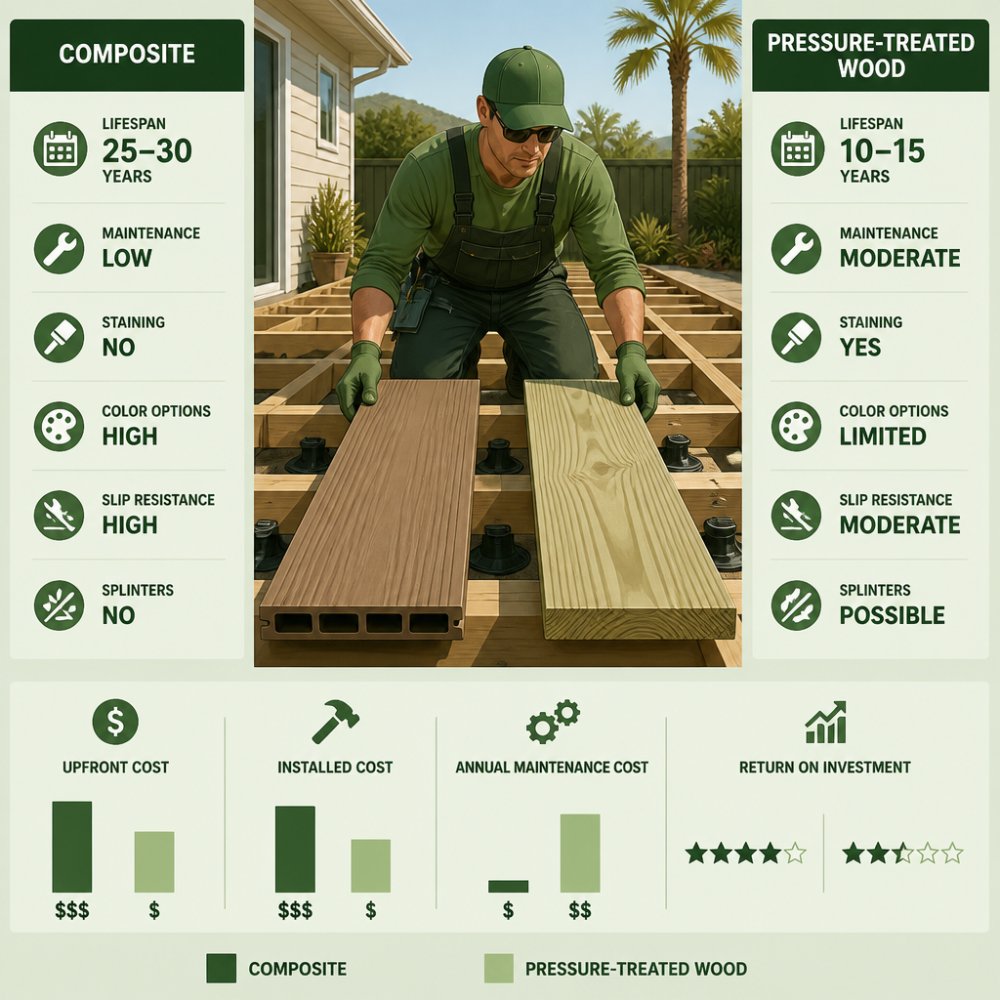
The composite versus pressure-treated wood decking decision comes down to upfront budget versus long-term upkeep, but the real differentiator is how each material behaves under your climate and interacts with your existing substructure. Pressure-treated lumber costs less to buy and install, while composite boards cost more initially but demand far less maintenance over their lifespan.
Upfront Cost and Installation Labor
Pressure-treated wood is the budget-friendly entry point, widely available and quick to install with standard tools and fasteners. Composite decking carries a higher material cost and often requires specific hidden clip systems, adding installation labor. Composite boards also expand and contract with temperature changes, so installers must follow the manufacturer's gapping requirements precisely, too tight and the boards buckle in summer heat; too loose and the gaps collect debris.
- Pressure-treated wood: Lower material cost, fast installation with standard deck screws, needs regular sealing
- Composite: Higher material cost, clip-based fastening, minimal ongoing treatment, requires precise gapping
- Labor factor: Composite installs can take longer due to fastener systems, board spacing, and sometimes additional framing adjustments
Durability, Rot, and Insect Damage
Pressure-treated lumber resists rot and insects through chemical treatment, but it still absorbs moisture and can warp, cup, or splinter over time. The treatment protects against fungal decay and termites, but it does not stop the wood from moving as humidity changes, and in freeze-thaw climates, water enters small cracks, freezes, expands, and widens them season after season.
| Material | Moisture Resistance | Rot & Insect Risk | Maintenance Level | Best For |
|---|---|---|---|---|
| Pressure-treated wood | Moderate | Moderate to high | Staining and sealing every 2-3 years | Tight budgets, short-term ownership |
| Composite | High | Low | Occasional cleaning | Low-maintenance households |
| PVC | Very high | Very low | Minimal | Coastal or wet climates |
| Hardwood | High | Low | Periodic oiling | Premium natural look |
Climate-Specific Performance
Here is how the same materials behave across three common climate profiles:
- High humidity and coastal fog: PVC and capped composite outperform. Pressure-treated wood stays damp for longer periods, creating ideal conditions for mold and mildew. Hardwood can work but requires more frequent oiling to prevent surface mold.
- Arid and intense UV: Composite and PVC hold color better than untreated wood, but darker boards absorb heat. Pressure-treated wood dries out and can crack if not sealed. Light-colored PVC or capped composite with UV inhibitors is the safer choice.
- Freeze-thaw cycles: Composite and PVC resist moisture intrusion that causes wood to split. Pressure-treated wood needs careful sealing and may still develop surface checks. Joist spacing and drainage matter more in this climate than in any other.
Substructure Compatibility
Switching from wood to composite or PVC is not always a simple board swap. Composite and PVC boards often require joist spacing of 12 inches on center for diagonal installations, while many older wood decks were framed at 16 inches on center, so you may need to add or sister joists. Hidden clip systems are also manufacturer-specific, so fasteners cannot be mixed and matched.
Low-Maintenance Deck Material Options
Low-maintenance deck material options center on composite, PVC, and capped boards that skip the annual staining and sealing routine while resisting moisture, mold, and mildew and holding color longer than untreated wood.
Best Decking Materials for Longevity
The best decking materials for longevity balance rot resistance, UV stability, and structural strength. PVC and capped composite lead for lifespan, while hardwood and well-maintained pressure-treated lumber remain solid choices.
- PVC and capped composite: Longest lifespan, minimal upkeep
- Hardwood: Durable and beautiful, requires oiling
- Pressure-treated wood: Solid when sealed regularly
- Key detail: Proper joist spacing prevents sagging and cupping
Long-Term Total Cost of Ownership for Backyard Decks
Total cost of ownership is where the real comparison happens. A cheaper board that needs staining and sealing every couple of years can cost more over two decades than a pricier composite that needs only occasional cleaning, but only if you break down the actual cost categories and apply them to your climate, maintenance habits, and timeline.
The Four Cost Categories That Matter
Most guides focus only on material cost per square foot. A complete total cost of ownership model includes:
- Upfront material and installation: The visible cost. Pressure-treated wood is lowest, composite is mid-range, PVC and hardwood are highest. Installation labor varies with fastener systems and substructure condition.
- Recurring maintenance: Staining, sealing, cleaning, and minor repairs. Pressure-treated wood typically needs staining and sealing every two to three years. Composite and PVC need occasional cleaning, typically once or twice a year.
- Repair and replacement: Rot repair, board replacement, and fastener replacement. Wood decks are more likely to need individual board replacement after ten to fifteen years. Composite and PVC boards are less likely to rot but can crack or fade if the substructure fails.
- End-of-life disposal or recycling: Treated wood must go to approved disposal facilities. Composite and PVC recycling options are growing but not universally available.
A 10-Year and 20-Year Framework
Over ten years, pressure-treated wood typically costs less upfront but adds recurring expenses for stain, sealant, and labor. Composite and PVC front-load the cost but reduce ongoing spending. Stretch that to twenty years, and the gap narrows or reverses, especially if the wood deck needs board replacement from rot or insect damage.
Maintenance Cost Categories to Budget For
Rather than guessing at a single per-square-foot number, budget by category:
- Cleaning supplies and tools: A pressure washer, deck cleaner, and brush. One-time purchase, reused for years.
- Stain and sealant: Needed every two to three years for wood. Cost scales with deck size and product quality.
- Labor for staining and sealing: If you hire out, this is the largest recurring cost. If you do it yourself, it is time, not money.
- Board replacement: Budget for replacing a small percentage of boards every five to ten years on a wood deck.
- Fastener replacement: Screws and clips can fail over time, especially in coastal environments.
Why Generic Per-Square-Foot Estimates Fail
Pricing for any deck project depends on square footage, material grade, site access, and design complexity. A deck built on a slope with limited access costs more to install than a flat, easily accessible deck, regardless of material, and stairs, railings, and built-in seating add cost that per-square-foot estimates ignore. Get a detailed quote instead, with material, labor, and substructure work broken out separately.
The Luxury Remodeling Angle
For high-end projects, total cost of ownership shifts. Premium materials like PVC and capped composite are chosen not just for durability but for design consistency, they hold color and texture longer, which matters when the deck anchors a cohesive outdoor living space. Hardwood remains a luxury choice for its natural grain and warmth, but demands a maintenance commitment some homeowners prefer to avoid.
Substructure Compatibility and Eco-Friendly Disposal
Substructure compatibility and eco-friendly disposal decide whether a material swap is practical. Composite and PVC boards often work with existing framing if joist spacing meets the manufacturer's requirements, but some products demand tighter spacing than older wood decks provide.
- Check joist spacing before switching board types
- Verify fastener compatibility with hidden clip systems
- Plan disposal for treated wood through approved channels
- Ask about recycling programs for synthetic boards
Frequently Asked Questions
What is the best material for outdoor decks?
There is no single best material, but composite and PVC decking lead for low maintenance and longevity, while pressure-treated wood remains the budget-friendly standard. The right pick depends on your climate, how much upkeep you will accept, and how long you plan to stay in the home. In hotter inland areas, capstock composite and PVC resist fading and warping better than bare wood. A professional can match the material to your sun exposure, shade, and soil conditions.
How does climate impact the choice of decking material?
Climate drives how fast a deck fades, warps, or rots. Coastal fog and salt air accelerate corrosion on fasteners and encourage mold and mildew on wood, so stainless or hot-dipped galvanized hardware and moisture-resistant boards matter. Inland areas with intense UV and wide temperature swings push thermal expansion, so composite boards need proper gapping and hidden clips. Pressure-treated lumber holds up in most conditions but needs regular staining and sealing to survive wet winters.
Which decking materials offer the best return on investment?
Composite and PVC decking often deliver the strongest long-term return because they skip the recurring cost of staining, sealing, and board replacement that wood requires. Over a 15 to 20-year window, the total cost of ownership for low-maintenance options frequently lands below pressure-treated wood once maintenance labor is counted. Wood still wins on upfront price and can be the right call if budget is the deciding factor. A contractor can model both scenarios for your specific deck size.
What are common decking mistakes to avoid?
The most expensive mistakes happen before boards go down. Skipping proper joist spacing causes sagging and squeaks. Using the wrong fasteners on treated lumber leads to corrosion and loose boards within a few years. Ignoring thermal expansion gaps causes composite boards to buckle in summer heat. And choosing a material on price alone often backfires when maintenance costs pile up. A licensed contractor can spec the substructure and fasteners correctly the first time.
Ready to start your project?
CH&L Landscaping & Concrete serves Concord, Martinez, and the greater Bay Area. Get a free, no-obligation estimate today.
Get a Free Estimate