Hightouch Consulting Alternative: Luxury Landscape Design
Table of Contents
- Why Homeowners Search for a Hightouch Consulting Alternative
- Vetting Professional Landscape Contractors: What to Check
- Luxury Landscape Design Services: What Sets Them Apart
- Landscape Construction Project Timeline: What to Expect
- The Hightouch Consulting Alternative for Outdoor Living
- Common Mistakes When Hiring a Landscape Consultant
- Conclusion: Choosing the Right Partner for Your Backyard
- Frequently Asked Questions
Last Updated: September 13, 2026
Why Homeowners Search for a Hightouch Consulting Alternative
Homeowners searching for a hightouch consulting alternative usually aren't looking for data software at all. They're looking for a landscaping partner who actually shows up, communicates clearly, and finishes the job. This guide from CH&L Landscaping & Concrete explains how to find that partner.
The phrase itself gets borrowed from the tech world, where teams hunt for a reverse ETL and data activation platform to move customer data between systems. Applied to a backyard renovation, the same instinct applies: you want a single, accountable partner instead of juggling five subcontractors and a designer who disappears after the concept drawings.
Most frustrations trace back to the same root cause. A project stalls because no one owns the schedule, the budget drifts because change orders arrive without warning, and the finished space doesn't match the renderings. The fix isn't a better pitch. It's a better vetting process.
Below, we'll show you exactly how to evaluate contractors, what a realistic timeline looks like, and where most homeowners go wrong.
California Contractors State License Board consumer guide
Vetting Professional Landscape Contractors: What to Check
Vetting professional landscape contractors starts with verification, not conversation. Before you discuss design ideas, confirm the basics: a valid state license, active insurance, and a track record you can actually inspect.
License, Insurance, and Verification Steps
A licensed contractor holds a state-issued license tied to a specific classification. In California, the Contractors State License Board maintains a public database where you can check a license number, its status, and any disciplinary history (cslb.ca.gov). Run that check before you sign anything.
- Confirm the license number matches the company name on the contract
- Verify the license status is "active" and not expired or suspended
- Request a certificate of insurance for general liability and workers' compensation
- Call the insurer directly to confirm the policy is current
- Check for complaints or disciplinary actions in the state database
Questions to Ask Before You Sign
The answers reveal more than the brochure ever will. Ask who will be on site daily, how change orders get priced, and what happens if the schedule slips.
- Who is my single point of contact from start to finish?
- How do you handle unexpected site conditions or hidden utility lines?
- What is your process for change orders, and how are costs approved?
- Can you provide references from projects completed in the last year?
A contractor who hesitates on any of these is telling you something. Move on.
Luxury Landscape Design Services: What Sets Them Apart
Luxury landscape design services differ from standard landscaping in one key way: the design is treated as the foundation of the entire build, not an afterthought. Custom design, premium materials, and a defined process separate a lasting outdoor space from a quick cosmetic fix.
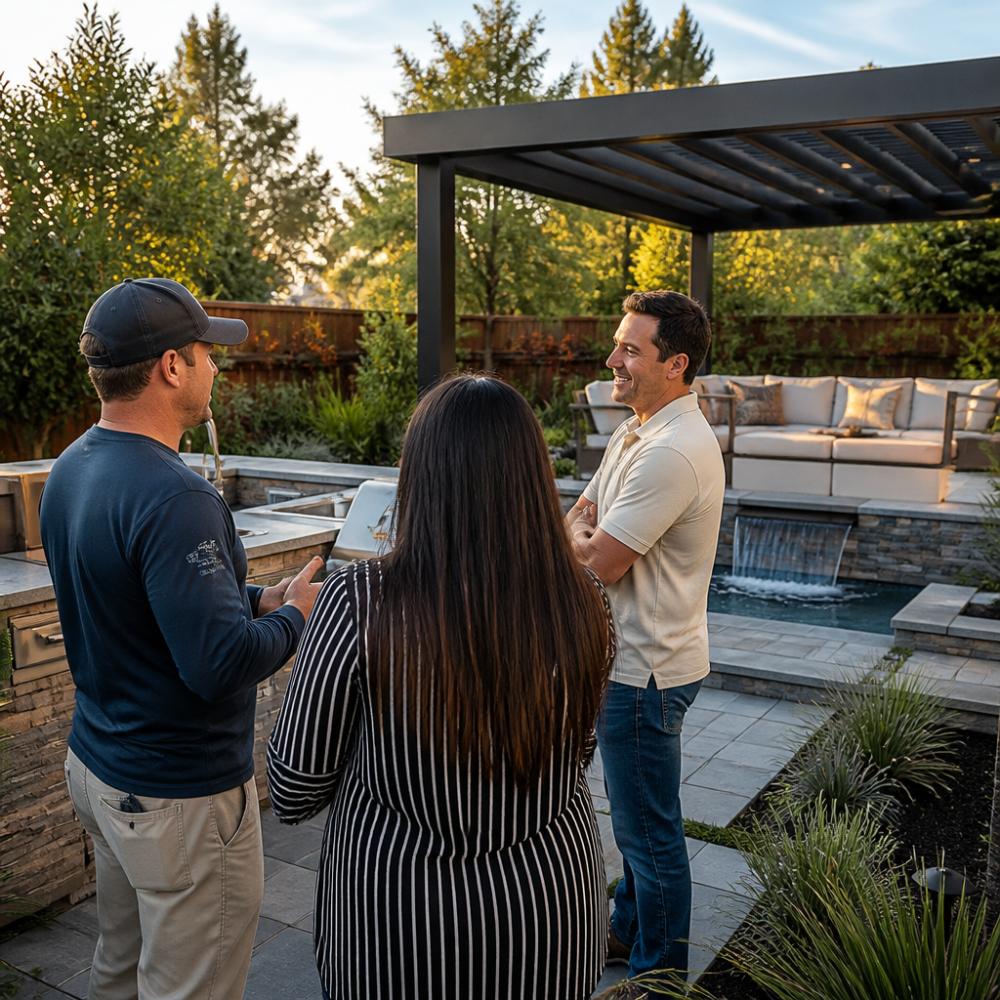
What most guides miss is that the design phase is where budget control actually happens. When the plan accounts for grading, drainage, and utility routing up front, fewer surprises surface mid-construction. At CH&L Landscaping & Concrete, custom design is included with every project, which means the plan and the build stay aligned from day one.
Water-efficient plantings and low-maintenance hardscape choices also matter more than most homeowners expect. A space you can manage yourself, season after season, is worth more than one that needs constant attention.
Landscape Construction Project Timeline: What to Expect
A landscape construction project timeline typically runs in phases, from initial consultation through a final walkthrough. The exact duration depends on scope, permitting, and material lead times, but the sequence stays consistent. What separates a well-run project from a stalled one is not the sequence, it is how tightly each phase is scheduled and how early long-lead items are ordered.
Design Phase Through Final Walkthrough
| Phase | What Happens | Typical Duration | What Can Stall It |
|---|---|---|---|
| Consultation | Site review, goals, budget discussion | 1-2 weeks | Unclear budget range or scope |
| Design | Concept drawings, revisions, approval | 2-4 weeks | Slow revision cycles, indecision on materials |
| Permitting | Applications and approvals if required | 2-8 weeks | Incomplete drawings, HOA review, grading or drainage triggers |
| Pre-construction | Material ordering, scheduling, site prep | 1-3 weeks | Long-lead stone, custom fabrication, equipment availability |
| Construction | Demolition, hardscape, planting, structures | 3-8 weeks | Weather, hidden utilities, change orders |
| Walkthrough | Final inspection and punch list | 1-2 days | Unresolved punch items, missing materials |
What Actually Drives the Schedule
Three variables move the timeline more than any other. First, permitting. Projects that touch grading, drainage, retaining walls above a certain height, or structures often require a permit, and review timelines vary widely by jurisdiction. A contractor who starts the permit application before the design is finalized is creating a re-submittal, which can add weeks.
Second, material lead times. Natural stone, custom pavers, and fabricated shade structures are frequently made to order. A common pattern is a two-to-six week lead time on specialty hardscape materials, which means ordering must happen during design, not after demolition. Contractors who order late are the ones whose crews stand idle.
Third, weather and site conditions. Concrete pours and certain finishes have temperature and moisture windows. Hidden utility lines, unstable soil, or unexpected rock can turn a two-day excavation into a two-week one. A realistic schedule builds in contingency for these rather than promising a firm date before the site is opened.
How to Read a Schedule Before You Sign
A credible schedule has three traits. It sequences permitting and material ordering before construction, not during it. It identifies the single point of contact who owns the schedule. And it states how change orders affect downstream dates. If a contractor gives you a firm completion date without asking about scope, permitting, or material selection, that date is a guess.
A realistic range for a mid-size luxury backyard, custom hardscape, planting, and one structure, is often eight to sixteen weeks from signed contract to final walkthrough, with permitting and material lead times accounting for much of the variance. Treat any estimate far below that range as a signal that something has been left out of the plan.
The Hightouch Consulting Alternative for Outdoor Living
The best hightouch consulting alternative for a backyard project is a full-service design-build contractor who owns the entire process. Instead of coordinating a separate designer, engineer, and installer, you work with one team accountable for the outcome. But "design-build" is a label, not a guarantee. The value depends entirely on how the model is structured and whether the contractor actually controls the trades.
What Design-Build Actually Replaces
In a traditional build, you hire a designer for drawings, then bid the work to a general contractor, who subcontracts the trades. Each handoff is a place where information is lost and accountability is diluted. Design-build collapses those handoffs into one contract. The same team that draws the plan builds it, which means the person who promised the drainage detail is the person who installs it.
The trade-off is real. You give up the ability to bid each trade separately, and you accept the contractor's markup on the whole scope. In exchange, you get a single point of accountability and a faster schedule, because design and construction can overlap instead of running sequentially.
How to Evaluate a Design-Build Contractor
Not every contractor who claims design-build actually operates that way. Use these tests to separate the real thing from a marketing label:
- Ask who employs the crew that will be on site. If the answer is "a subcontractor we always use," you are not getting design-build, you are getting a general contractor with a designer on staff.
- Ask whether the designer and the site supervisor communicate directly or only through you. Direct communication is the mechanism that prevents design intent from being lost.
- Ask for a project where the design changed mid-build and how it was handled. The answer reveals whether the process is real.
- Ask who is licensed and in what classification. In many states, the license classification determines what work the contractor is legally allowed to perform.
The Accountability Mechanism
What actually solves the disappearing-contractor problem is not the label, it is a defined process with named owners at each step. A contractor with a documented process can walk you through it in order: consultation, design, permitting, pre-construction, construction, walkthrough. A contractor without one will describe the work in general terms and rely on your trust.
Questions That Reveal the Real Model
- Who is my single point of contact from contract to walkthrough?
- Are the designer and the site supervisor the same company, or two companies under one brand?
- How are change orders priced, and who approves them?
- What happens if a subcontractor's work fails inspection?
- Can you show me a project completed in the last twelve months with a similar scope?
A contractor who hesitates on any of these is telling you something. Move on.
Common Mistakes When Hiring a Landscape Consultant
The biggest mistake is choosing on price alone. The lowest bid often omits site prep, drainage, or permit costs, then adds them back as change orders once work begins.
Other frequent missteps:
- Hiring before verifying the license and insurance
- Skipping reference checks on recent, similar projects
- Approving a design without discussing long-term maintenance
- Paying large deposits up front without a signed, itemized contract
- Ignoring drainage and grading in the plan
A common mistake is treating the design phase as optional. It isn't. It's the cheapest place to catch an expensive problem.
Conclusion: Choosing the Right Partner for Your Backyard
Finding the right partner comes down to verification, a clear process, and a team that stays accountable from design through the final walkthrough. The search for a hightouch consulting alternative really ends with a contractor who treats your backyard like a project they own.
CH&L Landscaping & Concrete brings 15+ years of experience, a valid CSLB license, and custom design included with every project. The team's four-step process, high-quality materials, and water-efficient approach keep outdoor spaces low-maintenance and usable year-round.
Get a free estimate from CH&L Landscaping & Concrete and start turning your backyard into a space built to last.
Frequently Asked Questions
Who are Hightouch's main competitors?
Hightouch operates in the data activation space, where platforms like Census, Polytomic, RudderStack, and Integrate.io offer overlapping reverse ETL and warehouse-native capabilities. Each tool differs in pricing model, sync latency, and how much engineering support it requires. If your goal is a Hightouch consulting alternative for a landscaping project rather than a data tool, the comparison shifts entirely to design-build firms with verifiable licenses, insurance, and completed projects you can visit.
What should I look for when vetting professional landscape contractors?
Start with a valid state contractor license and active insurance, then ask for three recent projects in your area you can visit in person. Confirm who pulls permits, how change orders are priced, and whether a written schedule is included. A contractor who includes custom design in the project scope, like CH&L Landscaping, gives you a single point of accountability from concept through installation instead of splitting design and build across two vendors.
How does a custom design process improve landscaping project outcomes?
A custom design locks in dimensions, materials, grading, and drainage before any digging starts. That upfront work reduces mid-project change orders, which are the most common reason budgets slip. It also lets you plan for water-efficient irrigation, shade structures, and low-maintenance plantings that fit how you actually use the yard. Projects with a completed design package typically move through permitting and construction with fewer delays than those built from a verbal plan.
What distinguishes a premium landscaping consultant from a general contractor?
A general contractor manages the build but rarely owns the design. A premium landscape consultant handles site assessment, design, permitting, hardscape and masonry installation, planting, and irrigation as one scope. That matters for luxury outdoor projects where the patio, deck, shade structure, and drainage all have to work together. Ask whether design is included, who supervises crews on site, and what warranty covers the finished work.
How long does a landscape construction project timeline usually run?
Timelines depend on scope, permit turnaround, and material lead times. A small patio or planting refresh may take a few weeks, while a full backyard build with hardscape, deck, masonry, and a pavilion can run several months from design approval to final walkthrough. Ask for a written schedule with milestones, and confirm how weather and inspection windows are handled so you are not surprised by gaps in the work.
Ready to start your project?
CH&L Landscaping & Concrete serves Concord, Martinez, and the greater Bay Area. Get a free, no-obligation estimate today.
Get a Free Estimate