Hiring a Landscape Contractor for Renovation in 2026
Table of Contents
- Why Hiring a Landscape Contractor for Renovation Demands More Than a Quick Search
- The Landscape Contractor Vetting Checklist: 7 Non-Negotiables
- Questions to Ask Landscape Contractors Before You Sign
- Understanding the Landscape Construction Project Timeline
- Landscape Design vs. Landscape Construction: Why the Distinction Matters
- Red Flags, Budgeting, and Post-Renovation Maintenance Planning
- Conclusion: Your Backyard Renovation Starts With the Right Contractor
- Frequently Asked Questions
Last Updated: September 8, 2026
Why Hiring a Landscape Contractor for Renovation Demands More Than a Quick Search
Hiring a landscape contractor for renovation is one of the most consequential decisions a homeowner can make, yet most approach it with less scrutiny than a kitchen remodel. A backyard renovation involves grading, drainage, irrigation, structural hardscaping, and plant selection, all of which interact with your home's foundation and property's natural water flow. When those systems fail, repair costs far exceed what a thorough vetting process would have caught upfront.
At CH&L Landscaping & Concrete, we have spent over 15 years transforming Bay Area backyards. The difference between a renovation that adds lasting value and one that becomes a money pit is almost always decided before a single shovel hits the ground. This guide walks through a checklist to evaluate any landscape contractor, questions that separate professionals from salespeople, and project management knowledge that helps keep renovations on time and on budget.
The uncomfortable truth is that the landscaping industry has a low barrier to entry. Anyone with a truck and a mower can call themselves a contractor. That is why the California Contractors State License Board maintains a searchable database of licensed contractors, and why verifying that license is the first step, not an optional courtesy.
The Landscape Contractor Vetting Checklist: 7 Non-Negotiables
A landscape contractor vetting checklist is your defense against the two most common failure modes: contractors who disappear mid-project and contractors who deliver shoddy workmanship. Before you compare bids or review portfolios, confirm seven baseline qualifications. Missing any one is grounds to move to the next candidate.
Verify License, Insurance, and Bonding
The single most important step in hiring a landscape contractor is verifying a valid California CSLB license. A license means the contractor has passed a trade exam, undergone a background check, and demonstrated financial solvency. You can verify this through the CSLB's online lookup tool, which also shows any complaints or disciplinary actions on file.
Insurance is equally non-negotiable. The contractor must carry general liability insurance, covering damage to your property, and workers' compensation insurance, covering injuries to their crew. If a worker falls on your property and the contractor lacks workers' comp, you can be held liable for their medical bills. Ask for a certificate of insurance and call the issuing agency to confirm it is active. Bonding provides an additional layer of protection if the contractor fails to complete the work or pay subcontractors.
Scrutinize Contracts, Payment Schedules, and Warranties
A professional contract is detailed and leaves nothing to interpretation. It should name exact materials, including brand and model numbers for pavers, fixtures, and plants, plus a start date, completion date, and clear work scope. Vague language like "install patio" is a red flag; "excavate 6 inches, lay 4 inches of compacted gravel base, install 2.5-inch concrete pavers with polymeric sand joints" is what you want to see.
Payment schedules are where many homeowners get burned. A common approach is a deposit of 10 to 15 percent, followed by progress payments tied to completed milestones. Never pay more than 10 percent upfront or make the final payment until the work is fully complete and inspected. California law caps down payments at 10 percent or $1,000, whichever is less, for licensed contractors (cslb.ca.gov). Your contract should also specify a workmanship warranty, typically one to two years, covering installation defects.
Questions to Ask Landscape Contractors Before You Sign
The questions you ask landscape contractors during the interview phase reveal more about competence than any portfolio. Ask how they handle change orders, which are inevitable in any renovation. A professional will have a written process for documenting changes, pricing them, and getting your signature before proceeding. A contractor who handles changes verbally is setting you up for disputes.
Ask who will be on site daily. Many contractors bid a job and then send subcontractors to do the actual work, often with less experience and no direct oversight. You want to know the project manager's name, their experience level, and whether they will be present during critical phases like site preparation and drainage installation. Ask for references from projects completed in the last 12 months, not three years ago, and call them. Ask specifically about communication: Did the contractor return calls promptly? Did they stick to the schedule? Were there surprise costs?
Understanding the Landscape Construction Project Timeline
A landscape renovation is not a linear process; it is a carefully orchestrated sequence of interdependent trades where each phase creates the conditions for the next. A realistic timeline for a full luxury backyard renovation can span several weeks. The difference lies in the complexity of the work: drainage engineering, structural hardscaping, and custom features require more time than a simple paver patio.
The Critical Path: Why Order Matters
The timeline is governed by a critical path that begins long before demolition. The first step is a comprehensive site assessment, including soil analysis and a percolation test. These tests determine how well your property drains and whether the soil can support new hardscaping. A soil report from a geotechnical engineer is non-negotiable for projects involving retaining walls over four feet tall or significant grade changes (osha.gov). Skipping this step is the leading cause of future settling, cracked pavers, and failed drainage systems.
Once the site is assessed, the sequence is as follows:
- Demolition and Site Clearing (3-5 days): Removing existing hardscaping, plants, and debris, and verifying the location of underground utilities, which must be marked by your local utility notification center before any digging begins.
- Rough Grading and Drainage (1-2 weeks): The most critical phase. The contractor shapes the land to direct water away from your home's foundation, installing French drains, catch basins, and sump pumps if required.
- Underground Utilities and Irrigation (3-5 days): All electrical lines for lighting, gas lines for outdoor kitchens, and water lines for irrigation are laid before any hardscape is installed. Ensure the irrigation system is zoned correctly and includes a rain sensor.
- Hardscape Base Installation (1-2 weeks): The longevity of any paver patio or retaining wall depends on the base: a layered system of 6-8 inches of compacted class II road base, followed by a 1-inch leveling bed of washed concrete sand. This is where contractors often cut corners, leading to settling within a year.
- Hardscape Installation (2-4 weeks): Setting pavers, building retaining walls, and constructing structures like pergolas. Timeline depends on pattern complexity; a herringbone pattern takes significantly longer than a running bond.
- Softscape and Planting (1-2 weeks): Installing plant material, spreading topsoil, and laying sod or seed after the hardscape is complete.
- Final Walkthrough and Punch List (1 week): The contractor should walk the site with you, documenting deficiencies on a punch list. This is not the time for final payment; inspect every detail, from paver alignment to irrigation operation.
Managing Delays and Change Orders
A professional contractor will build a buffer into the schedule for weather delays, the most common cause of timeline slippage. A contract should include a clause stating the timeline will be extended by the number of days work is stopped due to inclement weather.
Change orders are another source of delay. If you decide to add a fire pit or change paver color mid-project, the timeline will shift. A professional will provide a written change order detailing the new scope, adjusted cost, and impact on the completion date. Never approve a change verbally; always require a signed written document.
The Role of the Project Manager
The most significant factor in keeping a project on schedule is a dedicated project manager who coordinates crews, orders materials, and ensures work meets specifications. Ask who the project manager will be and whether they will be on site daily. A project manager juggling multiple jobs is a red flag.
A realistic timeline is a sign of a professional who understands the complexities of the work. A contractor who can articulate the critical path, the reasoning behind each phase, and potential risks is the one who will deliver a project that stands the test of time.
Landscape Design vs. Landscape Construction: Why the Distinction Matters
The line between landscape design and landscape construction is about the flow of information, the allocation of liability, and the ultimate accountability for the finished product. In a luxury renovation, where the margin for error is minimal, understanding this distinction is the difference between a seamless project and a fragmented one.
The Design Phase: More Than a Pretty Picture
Landscape design is an engineering discipline disguised as an art form. A professional landscape architect produces a set of construction documents that include:
- Site Plan: A scaled drawing showing the location of all elements.
- Grading and Drainage Plan: A detailed plan showing existing and proposed elevations, indicating how water will be directed across the property.
- Lighting Plan: A plan showing the location and type of all outdoor lighting fixtures.
- Planting Plan: A detailed plan specifying the species, size, and quantity of every plant.
- Construction Details: Cross-sections showing how retaining walls, paver bases, and outdoor kitchens are to be constructed.
These documents are the blueprint for the construction team. A design that lacks these details leaves too much room for interpretation, leading to costly mistakes.
The Construction Phase: Execution and Craftsmanship
Landscape construction translates those documents into physical reality. It requires knowledge of soil mechanics, concrete forming, masonry, and carpentry. A crew not used to working from detailed plans may improvise, compromising the design's integrity, for example, skipping specified geotextile fabric to save time, leading to weed growth and paver settling.
The Design-Build Advantage: A Single Source of Accountability
The most significant risk in hiring separate design and construction firms is the liability gap. If the patio settles, the designer blames the contractor, and the contractor blames the designer. The homeowner is caught in the middle with no single party responsible.
A design-build firm eliminates this gap. Because the same team handles both design and construction, there is a single point of accountability. The team that designs the project builds it, ensuring the design is buildable and the construction is faithful to the design. This model, which CH&L Landscaping & Concrete uses, streamlines communication and reduces errors.
Digital Visualization: Communicating the Vision
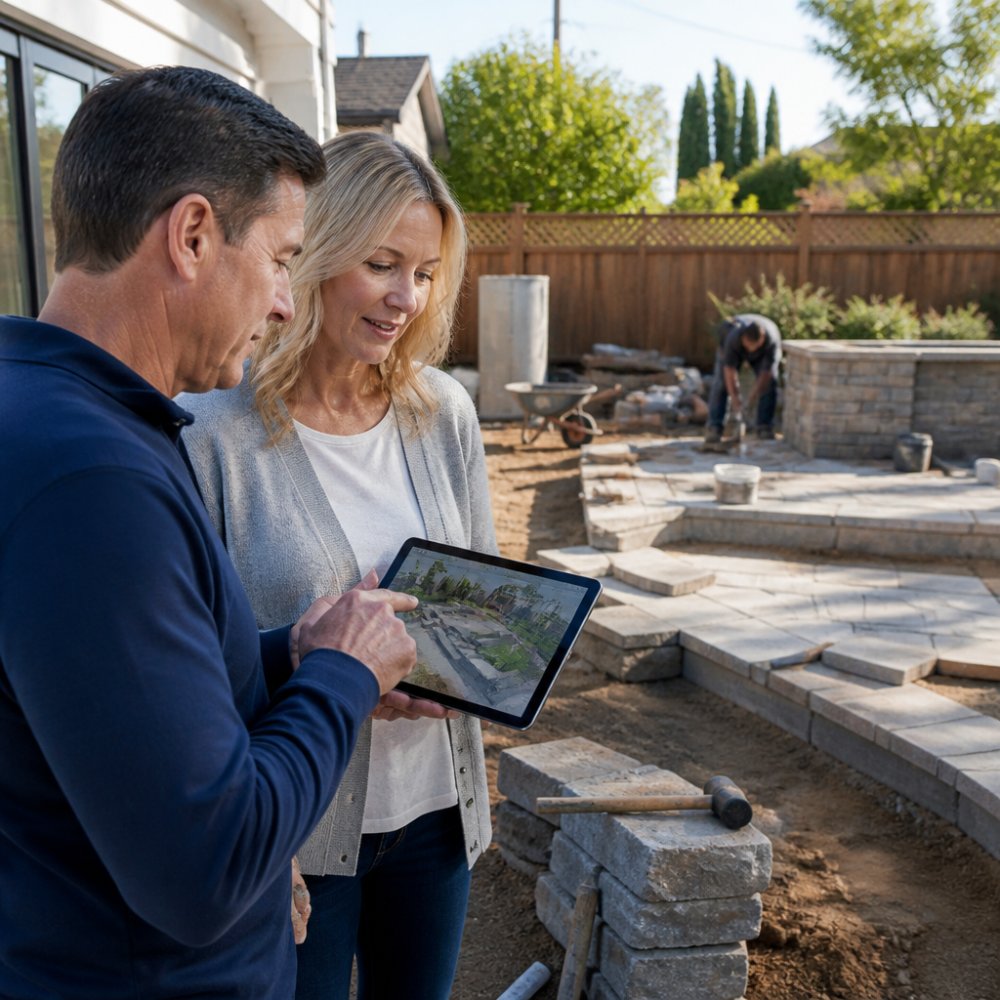
One of the most powerful tools in the design-build process is digital visualization. Advanced 3D rendering software allows the design team to create a photorealistic model of your project with accurate lighting, materials, and plantings. This is not a marketing gimmick; it is a critical communication tool.
A 3D rendering allows you to walk through your future space, identify potential issues, and make changes before construction begins. It is far less expensive to change a paver color in a rendering than to tear out and reinstall a patio. When interviewing contractors, ask if they use this technology.
The Contractual Difference
A design-build contract is typically a single contract covering both design and construction phases, simplifying the payment schedule and providing a clear scope of work. In contrast, a design-only contract requires you to hire a separate construction firm, managing two contracts, two payment schedules, and two sets of warranties.
When you hire a design-build firm, you are hiring a partner invested in the success of the entire project. This model delivers the highest level of quality and accountability, making it the preferred choice for luxury landscaping renovations.
Red Flags, Budgeting, and Post-Renovation Maintenance Planning
This section covers the three areas where most renovation projects go sideways: warning signs you should never ignore, budget realities most guides gloss over, and the maintenance plan that keeps your investment looking new.
Contractor Red Flags That Should End the Conversation
Certain behaviors should end the conversation immediately. A contractor who demands cash payment is almost certainly unlicensed and uninsured. A contractor who refuses to provide a written contract or pressures you to sign on the spot is looking for a quick close. A contractor who disparages other trades is showing you how they will talk about you to the next client.
The most telling red flag is a contractor who cannot clearly explain their own process. Ask about their approach to drainage, their method for compacting base material, and how they handle unexpected underground conditions. If they cannot answer with specifics, they lack the experience to handle your project. A professional contractor should walk you through their construction management approach, including how they coordinate subcontractors and handle daily site logistics.
Budgeting for Backyard Projects and Material Sourcing
Budgeting for backyard projects requires more than comparing bids. The lowest bid is often the most expensive option in the long run, reflecting lower-quality materials, less experienced labor, or a contractor who will hit you with change orders. A common approach is to get three detailed bids and compare them line by line.
Material sourcing transparency matters more than most homeowners realize. Ask where the pavers, lumber, and plants are sourced. A contractor who uses builder-grade materials will deliver a renovation that fails within a few years. A contractor who prioritizes high-quality materials will specify materials that withstand Bay Area weather and heavy use. Ask to see samples and visit a completed project to assess quality in person.
Planning for Post-Renovation Maintenance Planning
Post-renovation maintenance planning is the step almost every guide omits, yet it determines whether your investment holds up. A beautiful patio with poor drainage will heave and crack within two winters. Before you sign a contract, ask the contractor to walk you through the maintenance requirements of every element they are installing.
Low-maintenance landscaping does not mean no maintenance. It means choosing materials and plants that require less ongoing care: native plants adapted to the local climate, permeable pavers that manage water naturally, and drip irrigation systems that water efficiently. Ask your contractor to explain what you will need to do seasonally, from sealing pavers to pruning plants to winterizing irrigation. A contractor who cannot articulate a maintenance plan is not thinking about the long-term performance of their work.
Conclusion: Your Backyard Renovation Starts With the Right Contractor
Hiring a landscape contractor for renovation is a process of elimination, not a popularity contest. You are looking for a licensed, insured professional who communicates clearly, provides a detailed written contract, and can articulate a realistic project timeline. You are filtering out the red flags: cash-only demands, vague contracts, and bids that seem too good to be true.
The right contractor brings more than equipment and labor. They bring a site assessment that catches drainage problems before they become structural ones, a design that fits how your family actually uses the space, and a construction process that keeps you informed at every milestone. At CH&L Landscaping & Concrete, our proven four-step process includes custom design, high-quality materials, and a commitment to keeping projects on time and on budget, backed by our CSLB license and 5-star rating. We handle everything from the initial consultation to the final installation, so you get a seamless experience and an outdoor living space that adds lasting value to your home.
Get started with CH&L Landscaping & Concrete and request a free estimate to see what a properly managed backyard renovation looks like.
Frequently Asked Questions
How much do landscape contractors charge per hour?
Hourly rates vary significantly based on the scope of work, the contractor's expertise, and your region. For a full renovation, most reputable contractors provide a fixed project bid rather than an hourly rate. This bid should be itemized to show labor, materials, and overhead. Always request a detailed written estimate from multiple licensed contractors to compare bids fairly. Pricing depends on the specific project scope, materials selected, and site conditions.
What licenses should a professional landscape contractor hold?
In California, any contractor performing work valued at $500 or more for labor and materials must hold a valid license from the California Contractors State License Board (CSLB). For comprehensive renovation work involving hardscaping, a Class C-27 License is typically required. Always verify the license number on the CSLB website. A licensed contractor has passed a background check and a trade exam, and they are held to a higher standard of accountability.
What are the red flags to watch for when hiring a landscaping company?
Major red flags include demanding a large upfront payment before any work begins, being unable to provide proof of insurance or a license, and refusing to provide local references. Be wary of contractors who ask you to pull the permit yourself or who propose a vague contract without a detailed project scope. A professional contractor will welcome questions about their process and provide a clear, written plan for your project.
How can I tell if a landscape contractor is experienced in luxury hardscaping?
Ask to see a portfolio of completed projects that feature similar materials and complexity, such as custom stonework, pavers, or pergola installations. Inquire about their experience with site preparation and drainage solutions, which are critical for high-end hardscaping. A contractor with genuine experience will discuss the engineering and base preparation involved, not just the surface materials. They should also provide references you can contact.
Ready to start your project?
CH&L Landscaping & Concrete serves Concord, Martinez, and the greater Bay Area. Get a free, no-obligation estimate today.
Get a Free Estimate