How to Manage Landscape Construction: 2026 Guide

Table of Contents
- What Managing Landscape Construction Actually Involves
- Phase 1: Define Project Scope Before Any Dirt Moves
- Vetting Landscape Contractors: What to Verify First
- The Landscape Construction Contract Checklist
- Building a Realistic Landscape Construction Project Timeline
- Managing Budget, Procurement, and Change Orders
- Site Safety, Quality Assurance, and the Punch List
- Frequently Asked Questions
Last Updated: September 22, 2026
What Managing Landscape Construction Actually Involves
Managing landscape construction means coordinating design, permitting, site work, materials, labor, and inspections so a project finishes on schedule and on budget. At CH&L Landscaping & Concrete, we've run these projects for over 15 years, and the pattern is consistent: the smooth ones have a single point of accountability from survey to punch list.
Hardscape vs. Softscape: Two Tracks, One Schedule
Hardscape covers the built elements: patios, retaining walls, walkways, decks, and masonry. Softscape covers the living layer: planting, sod, irrigation, and soil preparation.
Phase 1: Define Project Scope Before Any Dirt Moves
Project scope is the written description of what gets built, from what, and what's excluded. Vague scope is the largest driver of budget disputes in residential landscape work.
A usable scope document answers five questions:
- What is being installed, by area and dimension
- Which materials, named by type and finish
- What site work is included (demolition, haul-off, grading)
- What is explicitly excluded (irrigation repair, tree removal, utility relocation)
- Who handles permits and inspections
Site Survey, Grading, and Drainage Planning
A site survey establishes existing elevations, property lines, utility locations, and drainage patterns. Skipping it shows up later as water pooling against a foundation or a wall built over an unmarked line.
Vetting Landscape Contractors: What to Verify First
Verify licensure first, then insurance, then completed work you can visit.
Then confirm two separate insurance documents:
- General liability, which covers property damage during construction
- Workers' compensation, which covers injuries to crew members on your property
The Landscape Construction Contract Checklist
A residential landscape contract should include the following before you sign:
- Scope of work with dimensions and material specifications
- Itemized pricing by phase, not a single lump sum
- Payment schedule tied to completed milestones
- Start date and substantial completion date
- Change order process, in writing, with a signature requirement
- Permit responsibility, named
- Warranty terms for workmanship and materials
- Termination clause and dispute resolution process
Building a Realistic Landscape Construction Project Timeline
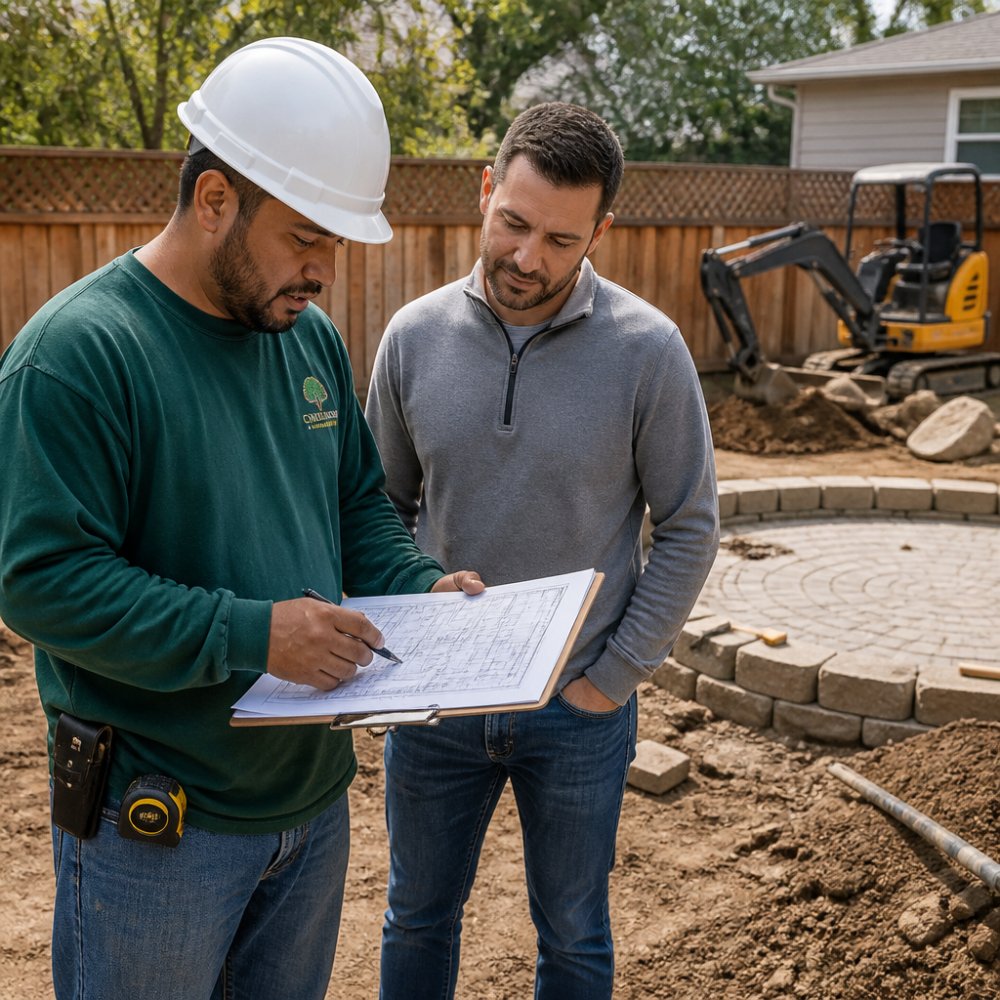
A realistic landscape construction project timeline budgets for permitting, inspections, and weather, not just installation. Most residential projects run several weeks to a few months, and installation is often the shortest part.
Critical Path, Permitting, and Weather Buffers
The critical path is the chain of tasks where any delay pushes the whole completion date: design approval, permit issuance, excavation, drainage and base work, hardscape installation, inspection, then softscape.
| Phase | Typical Duration Driver | Common Delay Cause |
|---|---|---|
| Design and approvals | Revision rounds | Undecided material selections |
| Permitting | Jurisdiction review queue | Incomplete submittals |
| Site prep and grading | Soil conditions | Unmarked utilities |
| Hardscape installation | Material lead times | Backordered stone or pavers |
| Softscape and punch list | Planting season | Irrigation conflicts |
Managing Budget, Procurement, and Change Orders
Budget control isn't about spending less, it's knowing where every dollar sits so design intent never gets value-engineered away by surprise. Three habits separate projects that hold their margin from those that bleed it: itemized estimates, locked-in material pricing, and a disciplined change order workflow.
The Change Order Workflow That Protects Margin
Change orders are where budgets quietly die. A client points at a wall and asks, "what if we bumped this out two feet?" The conversation is free. The work is not.
- Capture the request in writing the same day it is made, even if it is a text or email summary.
- Price it fully before any work begins: labor, material, equipment, disposal, and the schedule impact.
- Present the price with a signature line and a stated validity window, since material quotes expire.
- Get written approval before mobilization. Verbal approvals are how clients end up disputing invoices they do not recognize.
- Log it against the original budget so cumulative changes are visible, not buried across separate invoices.
Procurement and Supply Chain Tactics for Hardscape Materials
Material logistics is planning what arrives, when, and where it's staged. Stone, pavers, and lumber are heavy, and staging them wrong means paying labor twice to move them. The material is often the longest lead item and hardest to substitute.
Practical tactics that hold up:
- Order long-lead materials at contract signing, not at installation. Natural stone, custom pavers, and specialty lumber can carry lead times measured in weeks or months.
- Confirm dye lot and batch consistency for pavers and stone before the full order ships. A single mismatched pallet on a large patio is visible from across the yard.
- Lock pricing with a written quote and a stated validity period. Material pricing moves, and a quote from three months ago is not a commitment.
- Stage materials close to their installation zone, off the drainage path, and out of the way of equipment access.
- Verify delivery access before ordering, especially for gated, sloped, or narrow properties where a full-size delivery truck cannot reach the staging area.
- Name a substitution protocol in the contract: if a specified material is discontinued or backordered, who approves the substitute, and how is the price difference handled?
Budget Variance Tracking in Practice
A simple variance log, updated weekly, does more for margin than any single negotiation. For each line item, track original budget, committed cost, and projected final cost. The gap between committed and projected is your early warning system.
Site Safety, Quality Assurance, and the Punch List
Safety, quality, and closeout aren't separate phases, they're one continuous discipline owned by a single accountable manager from mobilization to final walkthrough. Split that accountability and the gaps become the client's problem.
Roles and Responsibilities on a Landscape Construction Team
A well-run project has named owners for each function, not a vague "the crew handles it" understanding. On a typical project, the roles break down like this:
- Project manager owns the schedule, the budget, the change order log, and client communication. This is the single point of accountability.
- Site superintendent or lead foreman owns daily sequencing, crew safety, and quality at each phase transition.
- Designer or design lead owns design intent and signs off on any field modification that affects the plan.
- Specialty subcontractors (masonry, irrigation, lighting, carpentry) own their scope, their safety, and their own quality control within it.
- Client owns decisions, approvals, and timely selections. Delayed selections are a schedule risk, not a contractor problem.
Managing Subcontractors Without Losing Control
Subcontractor management is about three things: clear scope boundaries, sequenced access to the site, and quality gates between trades.
- Scope boundaries. Each subcontractor's written scope names what they install, what they do not, and where their work ends. Overlap between trades is where finger-pointing starts.
- Sequenced access. Only one trade should be mobilizing in a given zone at a time. Overlapping trades in the same area is how finished work gets damaged and how injuries happen.
- Quality gates. No trade starts until the prior trade's work is inspected and signed off. Base compaction before pavers. Drainage slope before sod. Rough-in before finish.
Site Safety on Residential Projects
Site safety centers on excavation protection, utility locating, and equipment operation. Call 811 before any digging, and keep the locate markings visible for the duration of the excavation phase. On occupied properties, safety also means protecting the client's family, pets, and existing landscape from the work zone.
- Keep excavation edges barricaded and marked, especially where children or pets have access.
- Keep equipment keys secured when not in use.
- Maintain a clear path for emergency access at all times.
- Brief every crew and subcontractor on the site-specific hazards at mobilization, not just at the company level.
Quality Assurance at Phase Transitions
Quality assurance means inspecting at phase transitions, not at the end. Base compaction before pavers go down. Drainage slope before sod goes down. Once the next layer is installed, correcting the one beneath it gets expensive, and it also gets visible.
The Punch List and Closeout
The punch list is the final walkthrough document: every incomplete or defective item, listed, assigned, and dated. A project is not finished when the crew leaves. It is finished when the punch list is closed and signed by both parties.
Closeout also includes:
- A walkthrough with the client at a time of day when lighting and shadow reveal finish quality.
- As-built documentation of irrigation zones, lighting circuits, and drainage discharge points.
- Warranty terms in writing for workmanship and materials, with the start date of each warranty stated.
- A maintenance handoff so the client understands what the finished landscape needs in its first year.
Frequently Asked Questions
What are the most common mistakes in landscape construction management?
The biggest mistakes are starting work without a signed contract or approved drawings, underestimating site preparation and drainage, and letting change orders happen verbally. Each one leads to budget variance, delays, or disputes. A written scope, a documented change order process, and a realistic landscape construction project timeline prevent most of these problems before they start.
How do you keep a landscape project on schedule and on budget?
Lock the scope and drawings before breaking ground, build weather and permitting buffers into the schedule, and track budget variance weekly against your original takeoff. Order long-lead materials like pavers and shade structures early. When a change is requested, price it and get written approval before any work continues. This keeps the critical path intact and prevents surprise costs.
What should be included in a landscape construction contract?
A complete landscape construction contract checklist includes: scope of work with drawings, itemized materials and quantities, payment schedule tied to milestones, start and completion dates, change order procedures, permit responsibility, warranty terms, insurance and license numbers, and a punch list process. Anything left out becomes a future dispute.
How do you vet a professional landscape contractor?
Start by verifying the contractor's state license and insurance directly with the issuing board, not just from a card. Ask for three recent local projects you can visit, confirm who will actually manage your job, and request a written scope with itemized line items. Vetting landscape contractors on these points separates organized firms from those that disappear mid-project.
Ready to start your project?
CH&L Landscaping & Concrete serves Concord, Martinez, and the greater Bay Area. Get a free, no-obligation estimate today.
Get a Free Estimate